
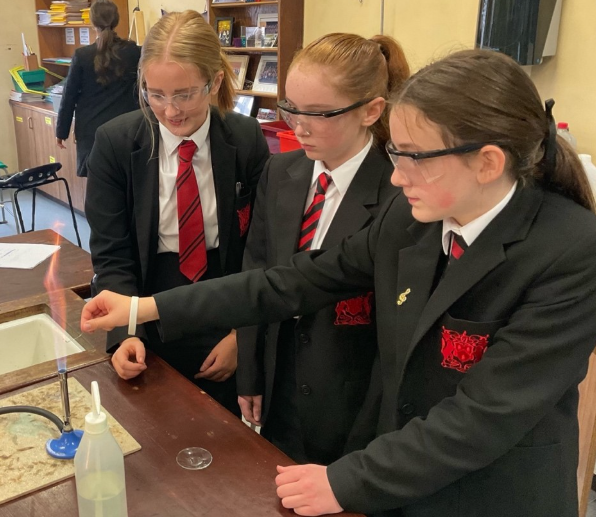
 Chemistry helps students understand the fundamental nature of matter, chemical reactions, and atomic structure. Chemistry encourages curiosity, problem solving, and analytical skills that extend across the curriculum. Its relevance is increasingly clear in today’s technology driven world, where challenges such as climate change, sustainable energy, materials innovation, and global health depend on chemical knowledge and research. Studying chemistry not only makes everyday phenomena—from rusting metals to medicines—more meaningful, but also opens pathways to diverse careers and equips young people with the scientific literacy needed to navigate and contribute to modern society.
Subject Aims
The Chemistry Department aims to:
- To inspire curiosity and a lasting interest in scientific discovery through engaging and meaningful chemistry teaching and learning.
- To build strong foundations in chemical knowledge, scientific literacy and examination technique.
- To develop safe, skilful, and increasingly independent practical learners.
- To create an inclusive learning environment where every pupil feels supported, challenged and able to achieve their potential.
- To foster excellent relationships and a positive, collaborative learning community.
- To connect chemistry learning to contemporary issues and highlight the wide range of future careers it can lead to.
Key Stage 3
At Key Stage 3, pupils are introduced to Chemistry as a taught component of the Junior Science course in Years 8 and 9, and as a separate discipline in Year 10. In Years 8 and 9, classes focus on developing pupils’ practical and analytical skills through hands‑on investigations that build confidence in the scientific method. Lessons are designed to be engaging and enjoyable, making effective use of ICT to enhance learning and curiosity.
In Year 10, Chemistry lays essential groundwork for Key Stage 4 by increasing students’ understanding of key chemical principles, strengthening practical and investigative abilities, and boosting confidence in exam skills. Pupils frequently complete deliberate practice using GCSE style past paper questions, enabling them to apply their knowledge effectively and develop the analytical skills required to interpret and respond successfully to exam questions.
Key Stage 4
At the Rainey, we offer three Key Stage 4 Science pathways. Pupils can study Chemistry through one of the following CCEA GCSE specifications:
- Single Award Science
A standalone, single GCSE covering all three sciences and a practical component. The intended grade range for this course is A*–C.
- Double Award Science
A double GCSE where all three sciences are taught and examined separately, with marks combined to award two overall Science grades. The intended grade range for this course is A*A*–CC.
- Triple Award Science
All three sciences are taught and examined separately, with pupils receiving individual GCSE grades in Biology, Chemistry, and Physics. The intended grade for this course is A*–C.
Please click the hyperlinked titles for further information
The CCEA Chemistry components of each GCSE specification develop students’ understanding of the material world and its impact on society. Through topics such as organic, quantitative, and electrochemistry, pupils strengthen their scientific process skills, along with their observation and problem‑solving abilities. Practical work is central to every course, supported by a dedicated Practical Skills unit that directly assesses hands‑on science alongside written examinations. Each specification includes at least three units, allowing pupils to complete part of the assessment before the end of the course.
AS and A2
At A level, pupils follow the CCEA GCE Chemistry specification, which comprises two stages: AS and A2. The course includes six externally assessed units:
- Unit AS 1: Basic Concepts in Physical and Inorganic Chemistry
- Unit AS 2: Further Physical and Inorganic Chemistry and an Introduction to Organic Chemistry
- Unit AS 3: Basic Practical Chemistry
- Unit A2 1: Further Physical and Organic Chemistry
- Unit A2 2: Analytical, Transition Metals, Electrochemistry and Organic Nitrogen Chemistry
- Unit A2 3: Further Practical Chemistry.
Students complete two theory papers and two practical papers across each year of study.
Studying A Level Chemistry provides students with a deep understanding of the principles that underpin the material world, while also preparing them for a wide range of tertiary level education pathways. Alongside advanced chemical knowledge, pupils develop highly transferable skills such as analytical thinking, quantitative reasoning, practical competency, problem solving and effective communication. Through rigorous experimental work and independent study, students learn to plan, investigate, evaluate and interpret data, skills valued not only in science based degrees, but across many academic and professional fields.
Extra-Curricular
Chemistry enrichment opportunities are offered through the Science Club, where pupils engage in challenges and activities which promote curiosity, teamwork and a deeper engagement with scientific thinking beyond the classroom. We also run the annual Mole Day baking competition. Both of these initiatives link with the school’s House system.
Pupils are also able to take part in national competitions such as the Chemistry Olympiad, which encourage them to apply their understanding and problem‑solving skills beyond the usual curriculum. Entering this competition demands independent thought, resilience and significant academic challenge.
Careers
Studying Chemistry provides a strong foundation for a wide range of future careers, including medicine, veterinary science, engineering, environmental science, pharmacology, forensics, and emerging fields such as green chemistry and biotechnology. As a department, we have built an extensive network of Rainey alumni working across these professions, enabling us to offer students tailored career advice, guidance on work‑placement opportunities, and valuable support with university applications.